Your Skin Is Smarter Than You Think
Skin gets treated like a wrapper. Something to moisturize, maybe protect from the sun, mostly ignore. That undersells it badly. Your skin is one of the most active organs you have, with a network of receptors that responds to what you put on it within seconds.
One of those networks is called the endocannabinoid system, or ECS. Researchers stumbled into it in the early 1990s while studying something else, and have been mapping it ever since. The ECS shows up almost everywhere in the body: the brain, the gut, immune tissue, and the skin itself. It helps regulate inflammation response, temperature sensitivity, and how quickly old skin cells get replaced. Quietly. In the background. All the time.
What Is the Endocannabinoid System?
Three parts. Endocannabinoids, which your body makes on its own. Receptors, which sit on the surface of your cells waiting for something to bind to them. And enzymes, which clean up the endocannabinoids once they have done their work.
The two main receptors are called CB1 and CB2. CB1 receptors cluster in the central nervous system. CB2 receptors live in your peripheral nervous system and in your immune cells. Both show up in skin tissue.
Endocannabinoids your body produces, like anandamide and 2-AG, bind to those receptors and help keep your internal chemistry in balance. Researchers call this homeostasis. Most days you never notice it happening, which is the point.
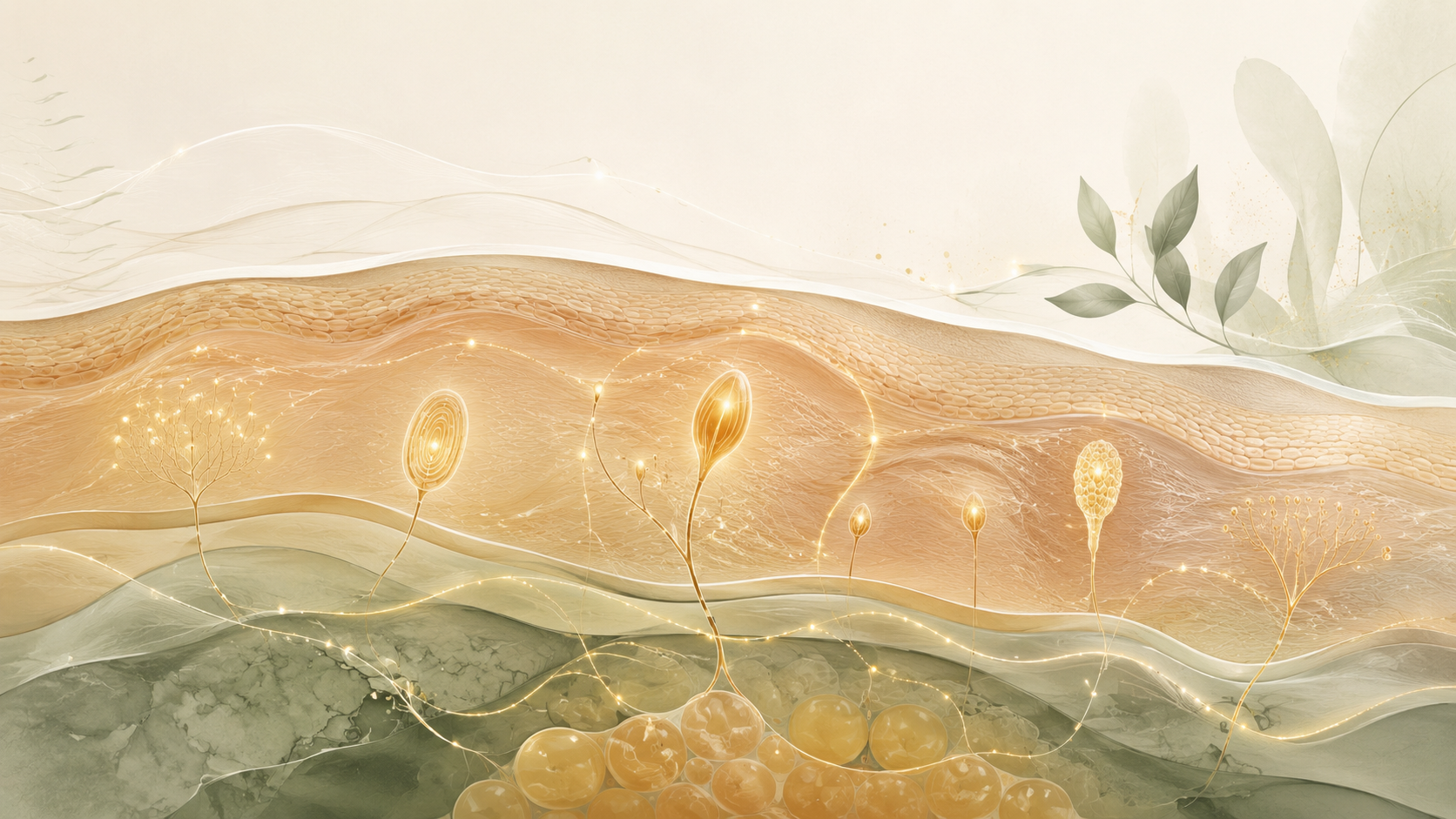
How Topicals Interact With the ECS
Apply a hemp-based gel or lotion to your skin, and the active plant compounds in it (called phytocannabinoids) reach the receptors in the tissue just under the surface. Those compounds do not enter your bloodstream. They stay where you put them, and they work on the receptors in that specific area.
Here is the part that matters. Phytocannabinoids in hemp are shaped similarly enough to the endocannabinoids your body already produces that they can engage the same CB2 receptors. So when you rub it into a sore forearm or a tight shoulder, the compounds support the body's natural response in that exact spot, and nowhere else.
Why Topical Application Is Different
Swallow something and it gets distributed everywhere by your bloodstream. Spread something on your skin and it works locally. That is the entire distinction, and it is bigger than it sounds. A hemp-infused gel rubbed into one knee does not travel to your other knee, your stomach, or your brain. It stays put.
For people who would rather not add another supplement to a cabinet that is already full, topicals make a lot of sense. You target the spot that needs it. You apply it the way you apply any other lotion. There is nothing else to track.
The Role of Supporting Ingredients
Phytocannabinoids do not work in a vacuum. A good topical pairs them with other botanical ingredients that bring their own mechanisms to the surface of the skin. A few of the ones worth knowing:
Menthol
Pulled from peppermint and other mints. It activates the TRPM8 cold-sensing receptors in your skin and gives you that fast icy feel as soon as it touches the area.
Arnica
A flowering plant Europeans have been using on the skin for hundreds of years. It works gently alongside hemp compounds while your body sorts itself out after a hard day.
Lavender
The calming part comes from linalool, a terpene that also shows up in hemp itself. In a topical, it adds a quiet aromatic layer and pairs well with the rest of the formula.
Eucalyptus & Peppermint
Two mints that give the formula a brighter sensory feel and help nudge surface circulation, which makes the other ingredients absorb a little faster.
What Does This Mean for You?
The biology is honestly not that complicated. Your skin came pre-wired to interact with compounds in hemp. A topical takes those compounds, hands them to the receptors in the spot you need, and stays out of everything else.
What still matters is what is in the bottle. Where the hemp was grown. Who grew it. What else is in the formula with it. We are partial to one specific answer to those questions, but you should ask them either way.